

The App That Turned a Town Against Itself
A smart-parking postmortem in a Malaysian town
Case File 001 — Domain: Public Digital Infrastructure | Pathology: Rollout Debt / UX Debt / Governance Debt | Evidence Level: Public Record + Direct Resident Report | Treatment Status: Proposed
What happened
In January 2026, a town in Malaysia launched a mobile parking app beside its paper coupons. The council gave the town six months to adapt: paper coupons remained valid until 30 June. For most of that time, most drivers used paper — the app was something other people would deal with later.
The six months passed. On 1 July, the paper option was switched off, and a system that had half a year to be ready failed on its first day of enforcement.
The result was a public storm that made national news. Enforcement officers issued RM 10 fines to people caught in the seconds between parking and paying while the network lagged. Citizens started driving motorcycles instead of cars — anything to avoid the app. The town's CBD went quiet during the day; people simply moved their errands to the night. Monthly-pass holders received "ghost fines" for license plates that resembled but did not match their own. The misreads were not rare enough to stay anecdotal: a lawyer reported that her employee's car — plate WYG7345, paid and confirmed in the app — was fined under WYG7745, a plate the car did not carry. The council chairman publicly attributed most misreads to non-standard plates, with letters like O and Q being read as zero, and claimed 99% accuracy for standard plates — which is another way of saying one plate in a hundred was read wrong. A monthly-pass holder fined for a misread plate was refunded only after complaining. Residents who had bought paper coupons in good faith waited seven working days to have their balances converted to electronic credits — by hand. And when the app did load, the progress bar sometimes read 1633%.
The chaos did not stop at the first wave. One resident parked on a main street in the town centre and paid through the app. He was fined anyway. He compared the two timestamps: the fine was issued ten seconds before his payment processed. He showed the enforcement officer his payment record. The officer's answer was to appeal.
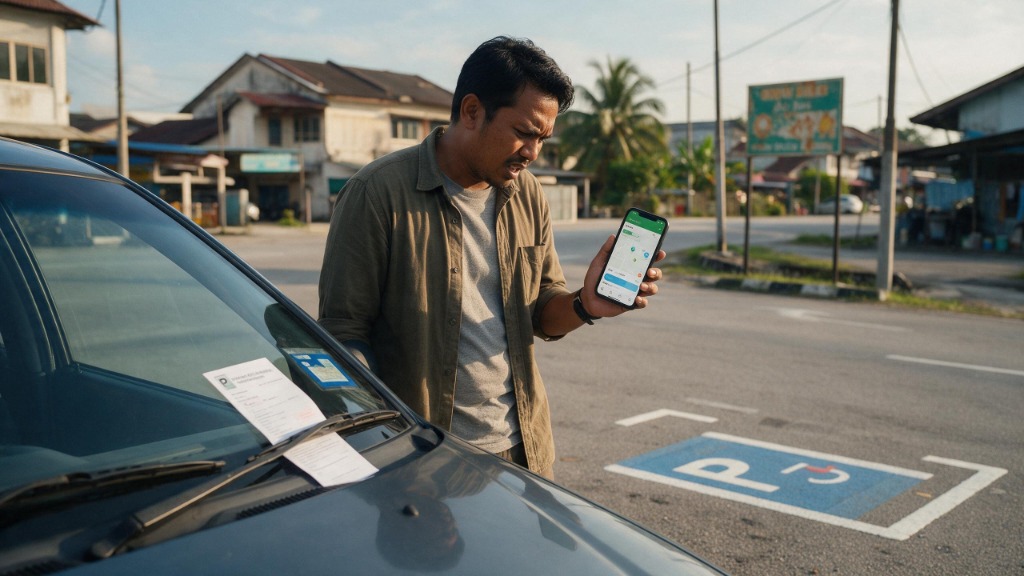
Parked, opened phone, waited for network connectivity—only to find a fine issued ten seconds before payment. The town's elected representatives were flooded with stories like this, and their public questions — reported in the local press — were pointed: why was the paper option switched off while the app still failed? Why did monthly-pass holders still receive fines? Why does this town charge more per hour than its own capital?
Twelve days passed — from the switch-off on the 1st to the announcement on the 13th — before the council issued what the press called a reprieve: the transition was extended to December 31, over-parking penalties were halved, and the paper coupons that had been dropped were accepted again. Counters were reopened for residents who cannot or will not use a phone. For now, the town runs two flows — paper and app — side by side. The relief arrived only after the town made itself impossible to ignore — and only for the parts of the system the public had shouted about.
The app is not marginal. It now claims more than 105,000 registered users in a town of this size, with more joining every month — growth that continued through the storm, as the council publicly defended the rollout even while acknowledging its failures. A system can be commercially productive and operationally pathological at the same time. At that scale, rollout mistakes stop being minor UX issues and become public-service failures.
One could argue the system is adapting — the reprieve, the reopened counters, the halved fines. As early as July, the council announced that e-coupons would be accepted across the whole town, with remaining time carrying over to the next location. There is a catch: as of late August, the app's purchase screen still asks drivers to choose between urban and non-urban — the interface still implies the old zone-locked pricing — and nothing in the app tells them the remaining time will follow them. The zone list was once streets; it became two. What was simplified was the count — not the model. The interface and the policy disagree — and the citizen pays for the disagreement. The relief exists only in a policy document and a news article; a driver who never read either could easily pay twice, exactly as before. And the remedy was never an engineering project — it was one line of text on the purchase screen: your remaining time carries over to your next location. In late August — nearly two months after the policy was announced in the news — the council's own transport official was still publicly explaining that remaining time carries over. The news explained it. The app never did. Instead, the council built a manual process: wrongly fined drivers report it, staff verify, and the fines are cancelled case by case — an ongoing administrative burden that the missing line of text would have made mostly unnecessary.
Update, September 2026: the purchase flow has since been simplified again. The urban/non-urban selector is gone, and the app now states directly that an e-coupon can be used throughout the town — the kind of interface-level repair the earlier policy change needed, with the rule finally visible where the citizen makes the decision. What was simplified in August was the count; what changed in September was the model. That repair deserves credit. But it does not touch the deeper failures documented here: payment reliability, plate misidentification, and repeated collection of sensitive documents — none of these lived in the zone selector. A reprieve is not a repair. It is a system running on two wheels while it waits.
What the symptoms say to someone who builds systems
I have spent sixteen years architecting and operating municipal-scale infrastructure. Most of the symptoms examined here are already visible in the public record; where I rely on a direct resident report, I label it explicitly.
The 1633% was not merely a network problem; it exposed a state-management problem. A progress indicator should never reach 1633%. Whatever happened underneath, the client allowed repeated or inconsistent progress updates to accumulate into a state that should have been impossible. An unstable network may have triggered the condition, but the software failed to contain it — a number that should not exist is the signature of a client that did not tolerate network instability safely.
Zero grace punished the least-connected first. The moment between parking and paying was treated as a violation — and when the network is the weak link, that design guarantees the citizens with the weakest connectivity pay the price. The ten-second fine is the purest expression of it. Whether by design, by haste, or by the simple blindness of being inside the system, the design externalized the system's failure cost onto the citizen — and it was always the same citizens paying.
"Smart" was used the way the word always gets used — as a noun, not a capability. Putting a paper coupon onto a phone screen — select the zone, select the duration, pay, all by hand in the sun — is digitization. It is arguably more cognitive load than scratching a coupon. It is not intelligence.
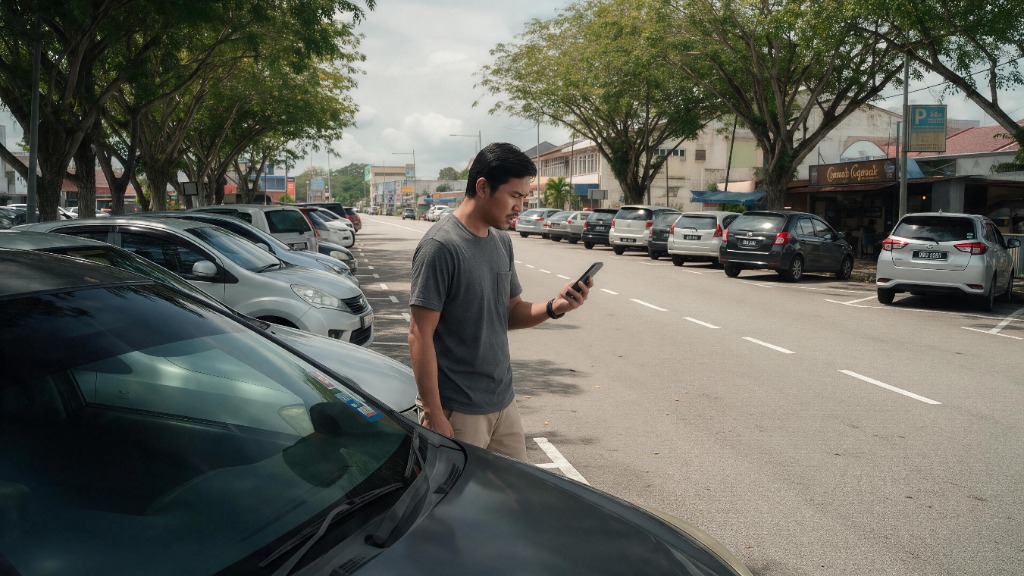
Selecting zones, durations, and payment methods under the midday sun is digitization—and more cognitive load than a paper coupon. And the collapse itself proved what the data was for: the system was already generating transactions, payments, enforcement records and operational signals — yet the public record shows no evidence that those signals translated into intervention before enforcement exposed the failure at town scale. Volume is a storage problem. Value is a decision problem — and this system had all the volume it needed, and none of the decisions.
The senior-citizen pass shows what the system believes about citizens. In response to the backlash, the council announced a RM 40/month pass for seniors — one IC, one car, with the names on the identity card, driving license, and vehicle registration certificate matching exactly. That last requirement deserves a closer look. Consider a car bought by a child, registered in the child's name, and used daily by an elderly parent for errands and medical visits. Under this rule the parent does not qualify: the name on the certificate is not the parent's name. The rule verifies legal ownership. The policy's purpose is presumably elderly mobility. Legal ownership is being used as a proxy for eligibility — and the two are not the same.
Verification itself is not the problem. A council may have legitimate reasons to look at an IC to confirm age, a licence to confirm driving eligibility, and a vehicle certificate to confirm the relationship between the applicant and the car. The governance question starts after the looking: verification is not retention. The council's notice does not say whether submitted copies are kept after verification, for how long, who may access them, whether they are scanned into a system, or how they are destroyed when no longer needed. A resident who applied in person told me that the submitted copies were retained by the council rather than returned after verification. I have not found a public notice explaining whether this is standard practice, how long the documents are retained, who may access them, whether they are digitised, or how they are eventually destroyed.
The auto-payment link announced on 27 August requires the same three documents in its published application requirements, submitted in person at the parking office because online applications are not yet available. For a senior who applies for both services, the published requirements therefore appear to duplicate the same proof — unless the council reuses an earlier verification. The system appears to collect the same proof repeatedly instead of reusing verified facts.
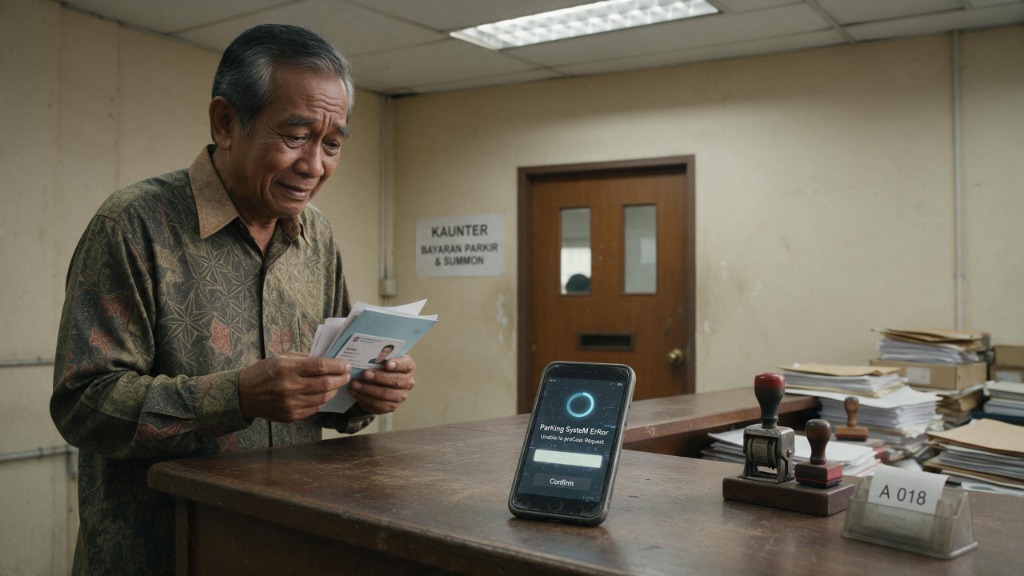
Verification is not retention—collecting sensitive physical documents repeatedly instead of recording verified facts. A better design verifies once and stores the result — age verified, licence verified, vehicle relationship verified, with a date and a reviewer — rather than re-collecting full sensitive documents for every related feature. If future online applications require these documents to be uploaded, the governance questions widen further: storage, encryption, access control, vendor reach, backups, deletion and breach exposure. The notice itself does not explain how those questions would be handled.
The two policies also disagree about what a family relationship means: one recognises the family relationship for payment; the other does not recognise the same family relationship for vehicle use. A public scheme that asks citizens for an IC and a vehicle ownership certificate should be able to explain what happens to those documents after verification — especially before asking for the same proof again, and especially when the scheme is specifically designed for senior citizens.
The exclusion was not a side effect; it was the plan's shape. The stories in the public complaints form a pattern: a shopkeeper from a neighboring town afraid to drive in because she cannot use the app; seniors without smartphones, without data plans, on streets where the signal is poor. Once the paper coupons were gone, one retired man in his sixties — who does not normally use a smartphone — had no choice but the app: he parked and began paying, and the fine arrived before he could finish. He now says he simply avoids the town centre. A public service that excludes citizens without the required device, connectivity or digital confidence is not universally accessible — it is a filter.
The design I would ship instead
These proposals have been part of my public writing for years. None of them belongs to any vendor. All of them start from one principle: a city system should absorb its citizens' friction, not hand it back to them.
1. Quick Park — asynchronous grace. Stop forcing a human to pay within seconds in the sun. Scan first; give the driver 72 hours to settle; the back office reconciles and auto-writes-off the rest. Enforcement becomes a calm administrative function instead of a public confrontation. The ten-second fine becomes impossible, because there is no clock to race. The grace window also changes who can use the system and when they have to engage with it: a senior who cannot operate the app can still park — one tap on a Quick Park shortcut on the phone's home screen, done — and a child home later in the day can settle the charge before it expires. Learning a new interface gets harder with age. For a senior who has not grown up with digital tools, every step inside an app is a threshold. The entry should be one step long. Every extra step creates another point where someone can be left behind. Someone rushing to an appointment can park first and pay on the way back. Parking no longer has to be completed in the seconds before walking away, and it no longer requires the person who parked to be the person who pays. If a session is allowed to auto-extend, the driver must be warned before it happens and notified when it does: a pre-expiry alert with an option to stop the extension, then a visual, audible and vibrating confirmation of what was charged and how to end the session — because a public system must not take money from a citizen silently, any more than it may fine one silently. A notice that arrives only after the charge is a receipt, not a warning. Outdoor settings are noisy; a chime alone is not a notice.
2. Open delegated payment. Turn a parking ticket into a bearer token with a QR code. A senior hands cash to the counter of a kopitiam — a Malaysian coffee shop that is really a hall of small food stalls — and the counter scans and pays. The town's smallest businesses become its payment infrastructure — zero hardware, zero exclusion, and a cash path for people who will never own a smartphone.

A senior hands cash to a kopitiam counter, and the merchant scans and pays via phone—the town's smallest businesses become its distributed payment infrastructure.
The same path serves the out-of-town driver who has no interest in registering an account for a single stop — under the current system, even the senior pass demands an account on the app before anyone can pay. Payment does not require a scan either: the parking session is registered under the licence plate, so anyone who enters the plate number can settle the charge for that car. A driver who forgot his phone can call home — someone at home types in the plate and pays. The council's new auto-payment link, by contrast, demands an application, three identity documents, and a linked account before a senior can pay automatically. This design needs none of that. The same mechanism could also become a local commerce tool: a kopitiam, a neighbourhood sundry shop, or a roadside stall could choose to pay part or all of a customer's parking as a service or a promotion — turning parking from a barrier to trade into something local businesses can actively use to attract footfall. Whether that meaningfully increases local spending depends on pricing, location and merchant economics — but the infrastructure would at least make that choice possible.
3. Data minimization — verify what is necessary, retain only what is necessary. Ask for the minimum evidence needed to establish eligibility. Where a document only needs to be inspected, record the verified fact rather than retaining the underlying document. Reuse existing verification across related services instead of collecting the same proof again. If the service cannot defend the data it already holds, it has no business expanding what it demands.
4. RFID or NFC for identification — stop reading plates altogether. Standardising plate fonts would help at the margins, but it still leaves the reader in charge of a task it is structurally bad at; identification that does not depend on reading a plate at all removes the failure class instead of reducing its rate. RFID suits machine-to-vehicle identification — a reader checking a passing car; NFC suits deliberate citizen-to-system verification — a driver tapping a terminal. An NFC implementation using cryptographically authenticated tags can offer stronger resistance to cloning; the choice between the two is a security and interaction decision, not merely a cost one. Misreads are not merely implementation bugs; they are a known failure mode of camera-based plate recognition. Rain, glare and angles defeat it, and so do characters that look alike — O and zero, Q and O, I and one, B and eight — on perfectly standard plates. A council chairman attributing misreads to "non-standard plates" misses the point: the ambiguity is in the letters themselves, and a system that fines on a single ambiguous read has no second line of defence. The same class of complaints has surfaced in other Malaysian digital parking rollouts. A low-cost card or tag identifies the vehicle without the system having to infer identity from visually similar letters and numbers — the ambiguity that produced the wrong-person fines is simply not part of this path. It also opens a path to the citizens this rollout excluded: a card needs no smartphone, no account and no data plan, and it could be issued at the same parking office that already handles walk-in applications. It has costs of its own — credentials can be lost, shared, cloned, or misprovisioned — but those are credential or provisioning failures that can be revoked, corrected or replaced, not a system silently fining the wrong citizen on an ambiguous read. And if enforcement still requires visual proof, the camera can remain — as an evidentiary record, not as the sole source of identity. Identification, observation and evidence are separate functions; this design stops letting one ambiguous read stand in for all three. This is not a new idea; it has been part of my public writing for years.
The lesson that travels
The public record is sufficient to diagnose the visible pathology without any insider detail. That is the point. A town does not need to know the internal story to see what its own system did — the symptoms contained enough evidence to expose the pathology, if anyone was trained to read them. There is no need to assume incompetence or malice. The deeper problem is structural: the people building and operating a system are inside it, and from inside a system, the citizen's journey can be the hardest thing to see.
Digitization is not intelligence. Enforcement without grace is not order. Collecting data you cannot protect is not governance. And a system that cannot serve the least-connected citizen it touches can hardly be called a universally accessible public service. It is closer to a tax on the vulnerable, wearing the word "smart."
A version of this story is being repeated across digitalization projects everywhere, with different apps and the same shape. The fix is not a better app. The fix is to stop asking citizens to pay for the system's design debt with their time, their money, and their trust.
"Growing from small to large is not hard. Staying disciplined after you have grown is."
Series Essays & Roadmap
Enterprise Pathology Case Files — Case Files show how I diagnose — Clinical postmortems of enterprise pathology